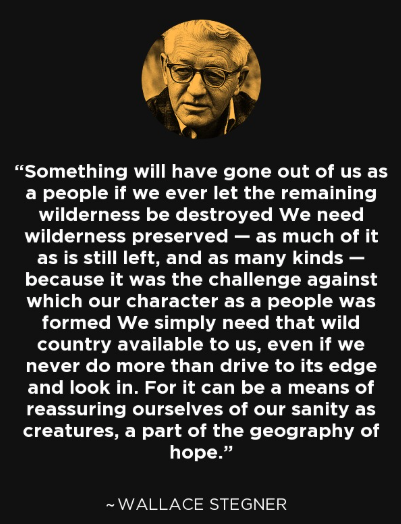
I’ve gotten away from reading Wallace Stegner. Not on purpose but I’m interested in so many topics right now, especially western American history that I haven’t been reading fiction or literary nonfiction as much. Now that I’m in a Master’s program I have access to JSOR where I can go down rabbit holes of literature and history.
This happened yesterday.
I read much of Bernard DeVoto’s work. I learned about him from being a Wallace Stegner groupie through most of my life starting in the 90s. Stegner wrote DeVoto’s biography and I became fascinated with DeVoto’s writing life, specifically all the essays written for the column, The Easy Chair. His writing was vibrant, electric – like nothing I’ve read before. He got so mad at people and politicians but the anger was everything I agreed with.
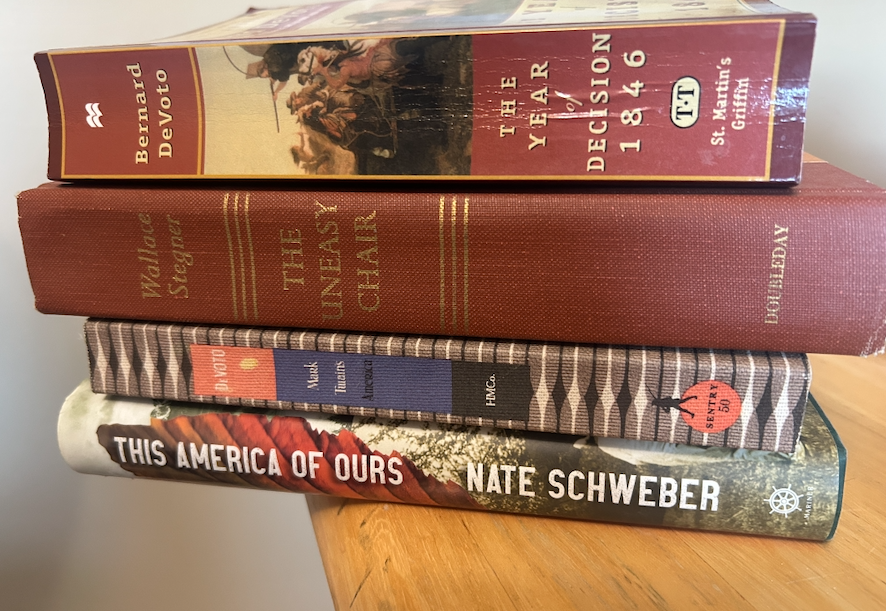
A few weeks ago something in my reading for my historiography class reminded me of DeVoto. In my class I’ve been reading and writing about the American frontier and Frederick Jackson Turner. When a writer mentioned DeVoto, I walked to my bookshelf and four books stand out:
Bernard DeVoto, The Year of Decision 1846.
Wallace Stegner, The Uneasy Chair.
Bernard DeVoto, Mark Twain’s America & Mark Twain at Work. The great author of the frontier seen by the Pulitzer Prize-winning historian of the frontier.
Nate Schweber, This America of Ours. Bernard and Avis DeVoto and the Forgotten Fight to Save the Wild.
Four pivotal books which I have read.
The Year of Decision 1846 is a difficult read. It’s intense and filled with action.
Schweber’s book is the most interesting to me right now. Schweber writes that the seeds of DeVoto’s life’s focus was to explain America. (11) This is so important for me since I’m trying to understand western American history and I know this will be my thesis in my Master’s program so I’m trying to read and synthesize all this information to formulate a writing plan. This book is so well written I am reading it again right now.
Additionally, the book highlights the environmental aspect of DeVoto and Stegner’s relationship that I’ve forgotten. Re-reading my highlighted, important sentences, Schweber reminds me: Bernard’s lifelong song was a “love for the country and contempt for the people who abused or gutted or colonized it.” (28)
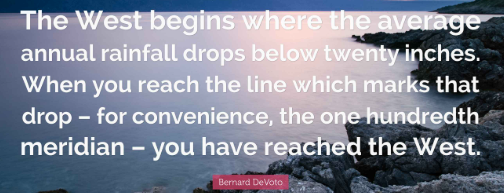
Which brings me to the article in JSTOR. The first article that I was searching for was a review on The Year of Decision 1846. I found a few articles about the book but also I was searching for an approach for my writing about history. I have aspirations to write a book about 1860 – a pivotal year in our nation due to the election of Lincoln, the southern slavery issue, westward advance and so much more.
The first article that popped up in my JSTOR search was perfect: “Bernard Devoto and the Making of the Year of Decision: 1846” by Louis P. Masur published in Reviews in American History, Sep., 1990, Vol. 18, No. 3. This was a retrospective review addressing issues, one specifically interesting to me right now: “popular versus scholarly history, history as a literary craft, and the problem of historical truth.” (438). This article is exactly what I need as I go down the rabbit hole of western history, how to write, how to write about history, and all the issues of historians writing western history.
In my historiography class we read about postmodernism and the literary turn, and DeVoto falls into these categories. Masur continues to discuss this idea: “While the best writing offered literary design, the best history offered dynamic complexity. Between the two was a tension with which all historians struggle, the tension between telling a captivating story and capturing the complexity to experience.” (439) How to tell a story with an interesting narrative and yet maintain the accuracy of what happened is truly a gift. The topics DeVoto covered in his book include all these fascinating topics: westward expansion, military conflict, religion, politics, technology, and more. (439) These are central themes and issues I want to write about in my future book.
The second re-discovery I make while searching through JSTOR is an article about Stegner and DeVoto. This article by Melody Graulich makes my head explode with excitement about writing, learning, understanding literature and history, and keys to a great life: “Quirky Little Things and Wilderness Letters: Using Wallace Stegner to Teach Cultural Studies and the Responsibilities of Citizenship” published in Teaching Western American Literature (2020). Graulich uses “Angle of Repose to teach research-based approaches to cultural studies of the West.” (41) She writes, “[Stegner] offers a way for teachers of introductory college classes to engage their students in larger questions about the central importance of responsibility and advocacy in their future roles as citizens, particularly concerning environmental issues in the West.” I need to hear this so much right now. Our nation is in trouble and needs help from our readers and writers, and people who are passionate about saving our environment. These readings all seem to converge for me at this point in my studies.
She writes about what the next generation of writer/advocates needs by quoting in the article about the responsibilities of writers and historians:
“‘You speak of the writer’s involvement in his society. I think too many writers are far too little involved. They sit in the middle of their own skulls, or their endocrines, and snipe at the saints, politicians, working people, housewives, and bureaucrats who have to keep the world running. This doesn’t mean I am anti- literary. The highest thing I can think of doing is literary. But literature does not exist in a vacuum. . . . We are neither detached nor semi- detached, but are linked to our world by a million interdependencies. To deny the interdependencies, while living on the comforts and services that they make possible, is adolescent when it isn’t downright dishonest.’” (Wallace Stegner and the American West by Philip L. Fradkin)
As part of her class Graulich assigns a task to her students to write letters to people on topics they care about. This is a reminder to me to write letters. I wrote a few letters to Tennessee state representatives last year but haven’t since. I will. This is important.
Graulich writes, “I want to train students to be insightful, lifelong readers, but I also feel it’s my responsibility, especially at a public land- grant university, to encourage them to become good citizens.”
I’d like to end on what I’m re-discovering in Stegner, and what is giving me energy and excitement all over again for the future, for reading, for learning: “All of us have the obligation somehow to have some kind of concern for the species, for the culture, for the larger thing outside of ourselves. I’m sure that’s buried not too deeply in most of the books I’ve written.” (Conversations with Wallace Stegner, Richard Etulain)