Bernard DeVoto and Wallace Stegner, the West, the Frontier, and saving America from itself

I’ve gotten away from reading Wallace Stegner. Not on purpose but I’m interested in so many topics right now, especially western American history that I haven’t been reading fiction or literary nonfiction as much. Now that I’m in a Master’s program I have access to JSOR where I can go down rabbit holes of literature and history.

This happened yesterday.

I read much of Bernard DeVoto’s work. I learned about him from being a Wallace Stegner groupie through most of my life starting in the 90s. Stegner wrote DeVoto’s biography and I became fascinated with DeVoto’s writing life, specifically all the essays written for the column, The Easy Chair. His writing was vibrant, electric – like nothing I’ve read before. He got so mad at people and politicians but the anger was everything I agreed with. 

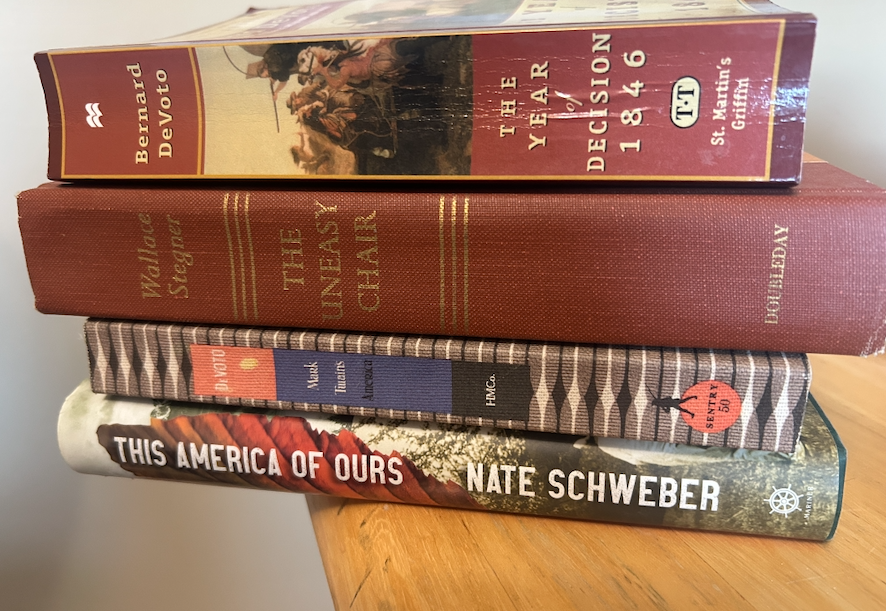
A few weeks ago something in my reading for my historiography class reminded me of DeVoto. In my class I’ve been reading and writing about the American frontier and Frederick Jackson Turner. When a writer mentioned DeVoto, I walked to my bookshelf and four books stand out: 

Bernard DeVoto, The Year of Decision 1846.

Wallace Stegner, The Uneasy Chair.

Bernard DeVoto, Mark Twain’s America & Mark Twain at Work. The great author of the frontier seen by the Pulitzer Prize-winning historian of the frontier

Nate Schweber, This America of Ours. Bernard and Avis DeVoto and the Forgotten Fight to Save the Wild.

Four pivotal books which I have read. 

The Year of Decision 1846 is a difficult read. It’s intense and filled with action. 

Schweber’s book is the most interesting to me right now. Schweber writes that the seeds of DeVoto’s life’s focus was to explain America. (11) This is so important for me since I’m trying to understand western American history and I know this will be my thesis in my Master’s program so I’m trying to read and synthesize all this information to formulate a writing plan. This book is so well written I am reading it again right now. 

Additionally, the book highlights the environmental aspect of DeVoto and Stegner’s relationship that I’ve forgotten. Re-reading my highlighted, important sentences, Schweber reminds me: Bernard’s lifelong song was a “love for the country and contempt for the people who abused or gutted or colonized it.” (28)
Which brings me to the article in JSTOR. The first article that I was searching for was a review on The Year of Decision 1846. I found a few articles about the book but also I was searching for an approach for my writing about history. I have aspirations to write a book about 1860 – a pivotal year in our nation due to the election of Lincoln, the southern slavery issue, westward advance and so much more. 

The first article that popped up in my JSTOR search was perfect: “Bernard Devoto and the Making of the Year of Decision: 1846” by Louis P. Masur published in Reviews in American History, Sep., 1990, Vol. 18, No. 3. This was a retrospective review addressing issues, one specifically interesting to me right now: “popular versus scholarly history, history as a literary craft, and the problem of historical truth.” (438). This article is exactly what I need as I go down the rabbit hole of western history, how to write, how to write about history, and all the issues of historians writing western history. 

In my historiography class we read about postmodernism and the literary turn, and DeVoto falls into these categories. Masur continues to discuss this idea: “While the best writing offered literary design, the best history offered dynamic complexity. Between the two was a tension with which all historians struggle, the tension between telling a captivating story and capturing the complexity to experience.” (439) How to tell a story with an interesting narrative and yet maintain the accuracy of what happened is truly a gift. The topics DeVoto covered in his book include all these fascinating topics: westward expansion, military conflict, religion, politics, technology, and more. (439) These are central themes and issues I want to write about in my future book. 

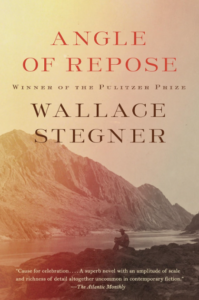
The second re-discovery I make while searching through JSTOR is an article about Stegner and DeVoto. This article by Melody Graulich makes my head explode with excitement about writing, learning, understanding literature and history, and keys to a great life: “Quirky Little Things and Wilderness Letters: Using Wallace Stegner to Teach Cultural Studies and the Responsibilities of Citizenship” published in Teaching Western American Literature (2020). Graulich uses “Angle of Repose to teach research-­based approaches to cultural studies of the West.” (41) She writes, “[Stegner] offers a way for teachers of introductory college classes to engage their students in larger questions about the central importance of responsibility and advocacy in their future roles as citizens, particularly concerning environmental issues in the West.” I need to hear this so much right now. Our nation is in trouble and needs help from our readers and writers, and people who are passionate about saving our environment. These readings all seem to converge for me at this point in my studies. 
She writes about what the next generation of writer/advocates needs by quoting in the article about the responsibilities of writers and historians: 

“‘You speak of the writer’s involvement in his society. I think too many writers are far too little involved. They sit in the middle of their own skulls, or their endocrines, and snipe at the saints, politicians, working people, housewives, and bureaucrats who have to keep the world running. This doesn’t mean I am anti-­ literary. The highest thing I can think of doing is literary. But literature does not exist in a vacuum. . . . We are neither detached nor semi-­ detached, but are linked to our world by a million interdependencies. To deny the interdependencies, while living on the comforts and services that they make possible, is adolescent when it isn’t downright dishonest.’” (Wallace Stegner and the American West by Philip L. Fradkin)

As part of her class Graulich assigns a task to her students to write letters to people on topics they care about. This is a reminder to me to write letters. I wrote a few letters to Tennessee state representatives last year but haven’t since. I will. This is important. 

Graulich writes, “I want to train students to be insightful, lifelong readers, but I also feel it’s my responsibility, especially at a public land-­ grant university, to encourage them to become good citizens.” 

I’d like to end on what I’m re-discovering in Stegner, and what is giving me energy and excitement all over again for the future, for reading, for learning: “All of us have the obligation somehow to have some kind of concern for the species, for the culture, for the larger thing outside of ourselves. I’m sure that’s buried not too deeply in most of the books I’ve written.” (Conversations with Wallace Stegner, Richard Etulain)
How To Be a Mountain Babe 2026 version

I had to laugh out loud when this article I wrote in 2010 came up on search.

Okay, it came up because I Google’d myself. Come on, don’t you? 

I remember, as clear as day, many things from the article:

  1. Working my first ski job where I traveled to all the company’s ski resort to train people on a “very beginning” CRM from 1999-2005. 
  2. Traveling to Park City for work and walking everywhere and exploring the city
  3. Reading about Kristen Ulmer
  4. And how all her points about mountain resort living are true, even 25 years later (although I don’t really live in a mountain resort town as of this writing)

Here’s what I wrote: 

Kristen Lodge – How to be a ‘Mountain Babe’

Sky-Hi News | Mar 12, 2010
Kristen Lodge / Outdoor Adventures (note: I wrote a weekly outdoor column from 2008-2011)
Grand County, CO Colorado

At 29 I got my first ski industry job and moved to my first ski town. Part of the job included traveling to ski resorts to train sales and marketing staff on sales software. The best part of the job was wandering around the ski town, eating breakfast and reading the local newspaper before a training class.

I clipped articles and photos from each town’s newspaper to remember the town and would add it to the list of places I might live someday; it’s a habit I’ve never lost.

I remember the day I read Kristen Ulmer’s article, How to Be a Mountain Babe, while sipping coffee and eating a bagel in downtown Park City. The article made me laugh out loud and wish my hair was long enough for pigtails.

I clipped the article and have re-read it over the years. It still holds true, even 10 years later, about ski town living, and it reminds me to live a healthy, outdoor lifestyle. Reading it now reminds me of all the cool mountain babes I’ve met over the years in all the ski towns I’ve lived in. Here is an excerpt of my favorite lines; used with permission from the author:

“In a mountain town, low-maintenance women who are excellent at sports and tell the occasional dirty joke are perfection.

“A baseball cap to keep the sun out of your eyes is standard. Two pigtails are now trendy and adorable, but remember their purpose is to keep hair out of way. And long nails … no way. If you’re a true mountain babe they’ll break.

“Smoking cigarettes is NOT cool (no exceptions), and drinking too much will hinder your athleticism. It’s OK to party, but remember, being in the mountains is about living a healthy lifestyle and enjoying the outdoors. And be careful who you “hook up” with, next week you’ll probably meet and fall in love with his best friend.

“Don’t expect to meet men, you’ll only meet boys (with toys) – and lots of them. Almost all have gorgeous athletic bodies and college degrees, but under that dirty baseball cap is a mono-dimensional play hog who’ll always choose climbing or powder mornings over cuddling or going for coffee.

“This is where “no whining” stickers are birthed. Even if you can’t keep up, a “wow that was great!” positive attitude goes a long way.

“A crummy, beat-up car is cooler than a new 4X4.

Must-haves are limited to top-shelf sports gear. Pick one sport, and obsess. Not only is it exceptionally fun to be really good at something, but you also want the glory of being called ‘that sick mountain biker with the honed legs’ or ‘the Betty who launches monster halfpipe tricks on a snowboard.’

“Take up other sports occasionally, just to prevent burnout and narrow mindedness.

Kristen Ulmer wrote this in 1999. She was a pioneer of Extreme Sports and a mogul specialist on the US Ski Team. In 2003 she started sports training, introducing mental and Zen aspects to winter sports in a clinic called Ski To Live. She is a called the “Ski Guru” by Outside Magazine.

“I’m proud of my ski career, and jumping off 70 foot cliffs was exciting, but not nearly as exciting as helping people access what they’re capable of – not just as athletes or business men and women, but as human beings.” Visit her website http://www.kristenulmer.com

She went from mountain babe, to mogul specialist, to life/business coach.

The mountain lifestyle can be tough at times, especially in a down economy. I’ve thought of leaving many times. I have friends with bigger homes, nicer cars, and larger 401Ks, but I like it here; trying to be a mountain babe.

Link to Source: ​​https://www.skyhinews.com/news/kristen-lodge-how-to-be-a-mountain-babe/

Thanks for reading.

Great Fiction to Read Patchett, Evans

I’ve been reading a lot lately, instead of running and hiking. It’s been so cold here (22 degrees as I write this) and I just want to sit on the sofa and read, with my dogs next to me. 

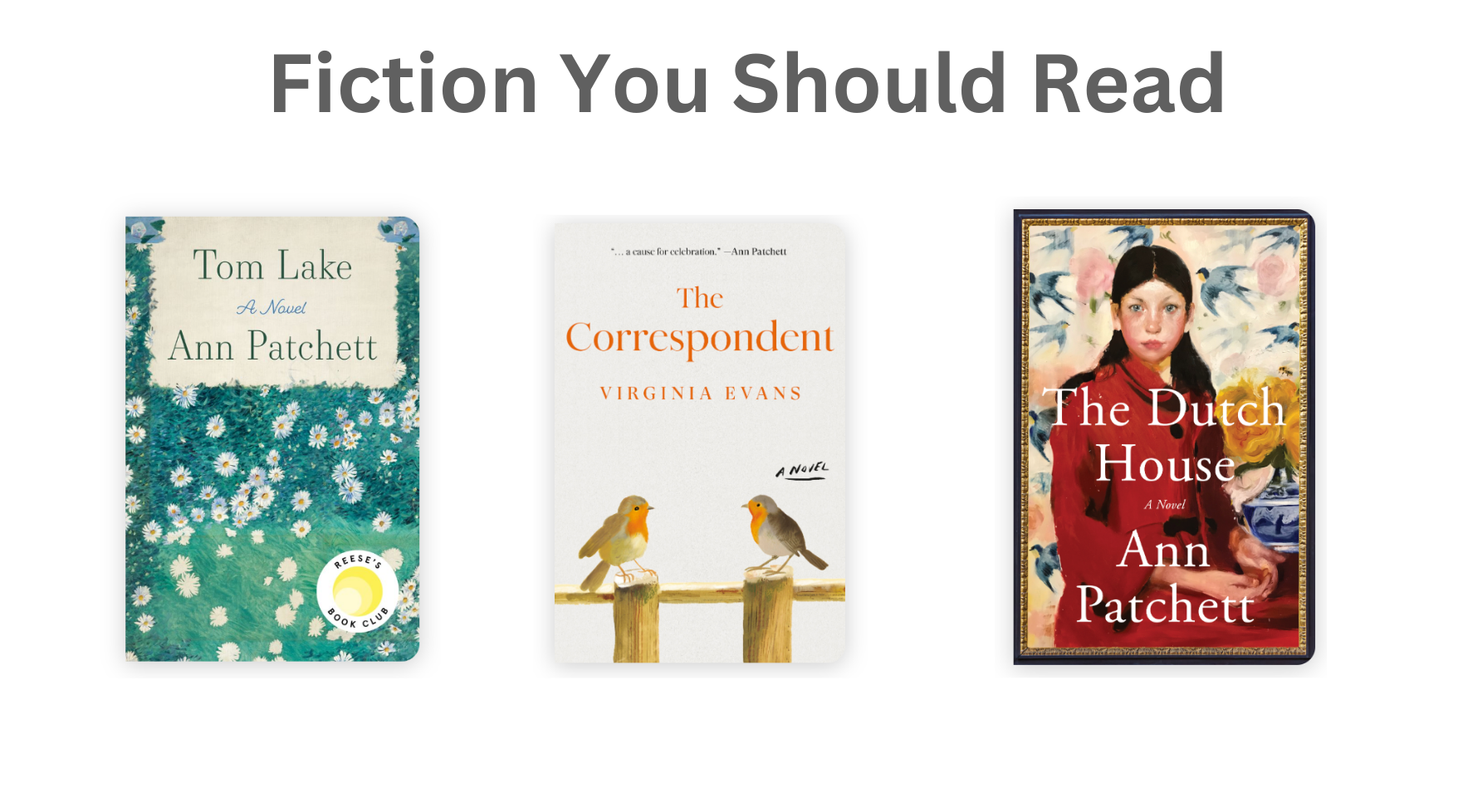
All my fiction-reading started with a review of the book, The Correspondent. I haven’t read fiction in a long time so I thought it would be a good change. When I looked at my bookshelf for something to read – all I saw was nonfiction. I needed to escape into fiction. 

The Correspondent is a book of letters that the main character wrote to her friends, family, authors and newspapers. What made this book so special to me was how deeply invested I became in all of the characters. They felt real to me and I could imagine where they lived and how they looked. I cared about their choices, their regrets, and the things they wrote to each other. 

I couldn’t put the book down and read it in two days. By the end, I was crying my eyes out.

The main character did all the things she was scared of. She was one tough woman. She made some bad choices throughout her life, like we all do.  It reminded me how powerful people’s stories are, and it made me want to write letters, reach out to family, friends AND newspapers and tell them exactly how I feel.

More than anything, it was a gentle but persistent reminder to fully live all of our days, no matter our age or where we think we are in life. I also think it was a lesson about aging.

It was my reminder that every person in my life is complex. I will never know what their inner life is. And, I will never truly understand why people do what they do. I think that is why I was balling my eyes out. We can never really know the people we love.

Additionally, I rarely read books from the New York Times Best Sellers list. The Correspondent didn’t land on that list until a full year after publication, purely through word of mouth. I have told every reader in my life, “You have to read this book.” 

After finishing this book, I wanted to start another book as soon as possible. I loved getting back into reading and being so absorbed in a story that I couldn’t wait to wake up to read it or get home from work to read a few chapters. I rarely turned on the TV.

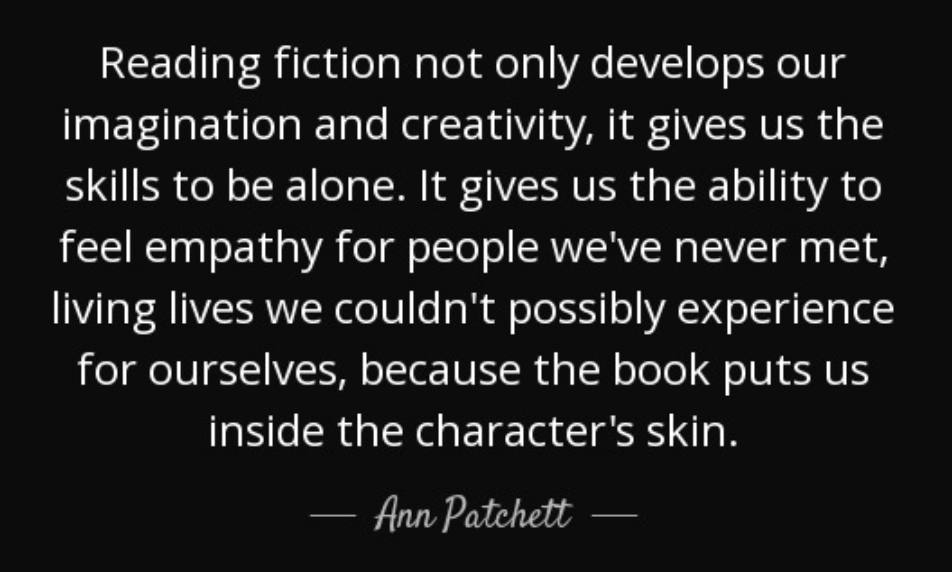
I remembered in The Correspondent , Sybil, the main character wrote a letter to Ann Patchett and Ann wrote back. Sybil wrote to many authors and I thought that was a clever twist, especially when they wrote back so I googled Ann Patchett and read a few reviews of her books. I decided my next read was Tom Lake. I remember hearing about it when it came out but never read it. 

Now, I’m reading it and it’s so good. It takes place in a fictional town in northern Michigan, where I’ve been. Plus, the mom was from New Hampshire and attended the University of New Hampshire, my alma mater. I liked how the story depicted Michigan and New Hampshire, and the fictional summer stock theatre by a lake. The characters are complex and compelling. I was drawn in instantly to the main couples’ story, including the surprise twist in how they met. I loved learning about the personalities of the three daughters. I loved how the mother’s past is slowly revealed through the book. I’m halfway through and can’t put it down (except wanting to write this post – perhaps to draw out the eventual ending to the book)

Patchett is such a great writer and storyteller. I loved, loved, loved her book, The Dutch House and read it twice. I also listened to the audio version narrated by Tom Hanks – so good!

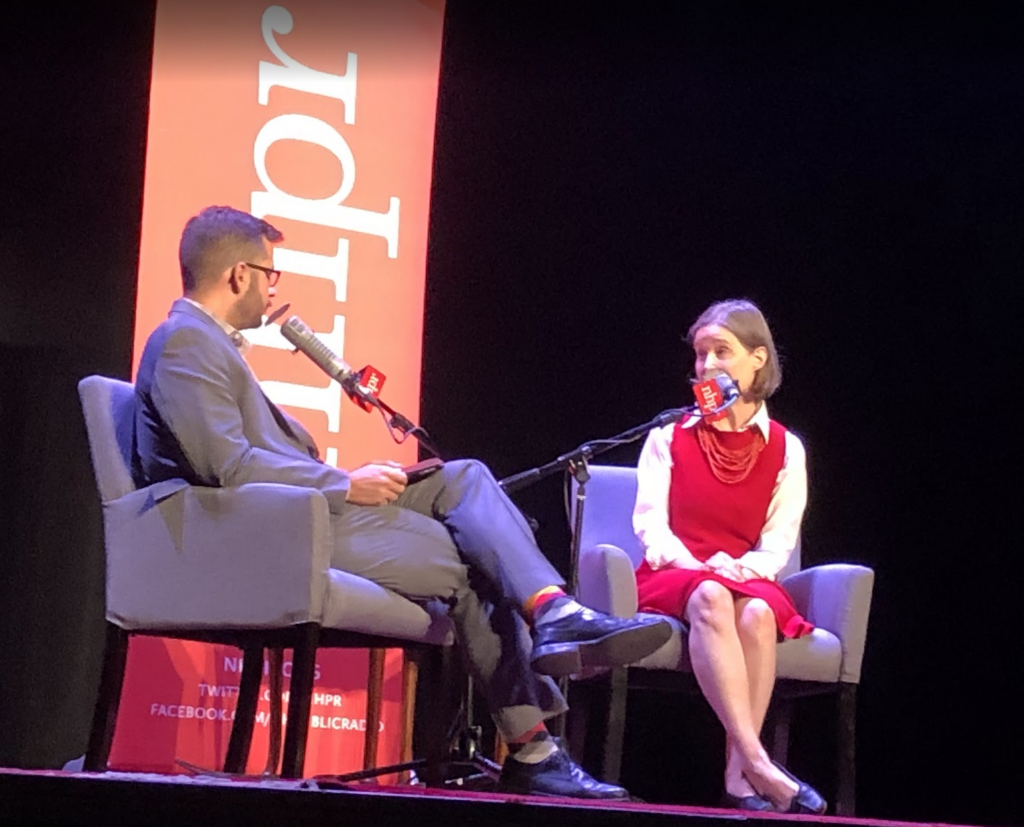
I remembered, too. I saw Patchett speak. It was 2019 and I was living in Concord, New Hampshire. I bought tickets to the event which included a signed copy of her new book, The Dutch House. The talk was held at The Capitol Center for the Arts’ so it was just a short walk downtown. Peter Biello was with her on stage and asked her questions. He worked at NHPR at the time and did a great job on stage. 

I found the above picture in my Google Photos from that night. I sat in the first row and was riveted by the conversation and wanted to learn everything I could about the writing life.

This is what I wrote in my journal from that night:

Ann Patchett was so awesome last night. I started reading The Dutch House once I got home and it’s good. One of the questions that she answered had to do with publishing. She said that it is your name: you do all the editing and make it be representative of your work. She talked about the idea of a home as a central theme in the book. She said our home is where we throw our lives. Home is emotionally charged. Every novel needs a home – it connects people.

She said the book is also about hurt feelings and the things that hurt us in our childhood. The idea that the characters can’t get out of the situation they are in – that is what she likes to write about. 

She said that part of her life she interviews authors and she reads all the time. She has a bookstore in Nashville. She said Margret Atwood’s new book is so good, as is Harlan Cobin. She was funny, smart and made me want to know all her books. 

She said all that matters is the white, hot center of your heart. Find that and write about that. It teaches you to access what you really care about. She said I can’t teach you about having something to say. Writing a novel is like swimming the channel. You have to stay in the present and you can’t look forward and you can’t look back. 

She said find the time to do what you love. If you have something to say you will find the time.

She makes me feel like reading and watching the news and being involved in this crazy world.  Going to an author reading does energize me and brings me back to the world. I laughed and genuinely enjoyed the conversation. She was really engaging.

Twenty years ago I bought Patchett’s 2004 memoir, Truth & Beauty, about her friendship with Lucy Grealy. I thought her story of coming up as a writer was fascinating. 

The point of this post is really just this: Ann Patchett is amazing- Read Her Books!  Virginia Evans is a wonderful storyteller – Read This One. These books have gotten me through a cold, snowy winter in East Tennessee.

Fall Books I’m Reading – This Contested Land by Long

It’s always this time of year I want to go back to school to get my masters or to learn new skills. I think to myself, I have enough money to go back to school, but then reality hits, and for tens of thousands of dollars I think I want to travel or put in a new kitchen … Maybe, let’s see what next fall brings. 

In the meantime, I’m in full on reading mode because it’s how I learn; and books always make me want to travel.

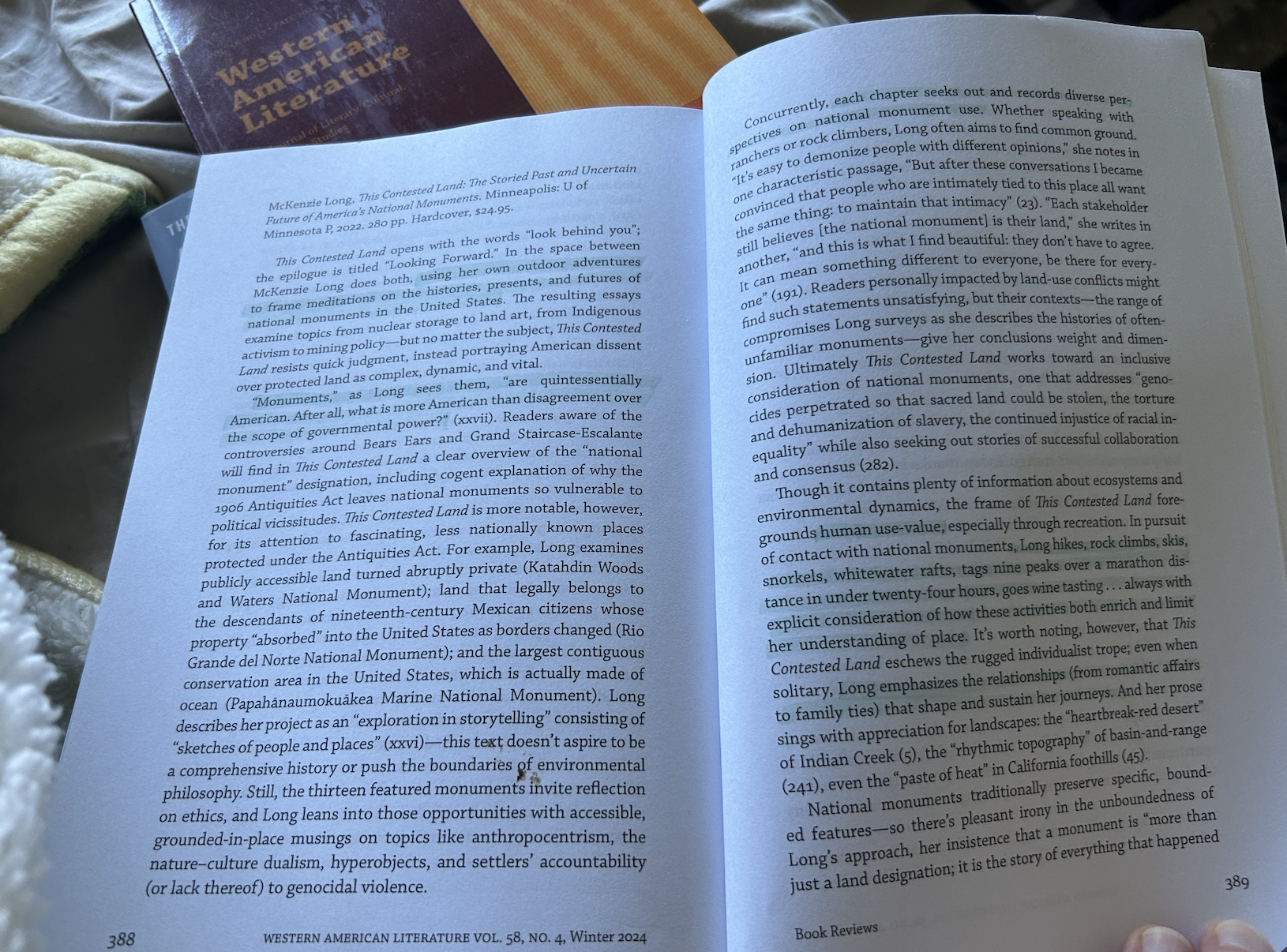
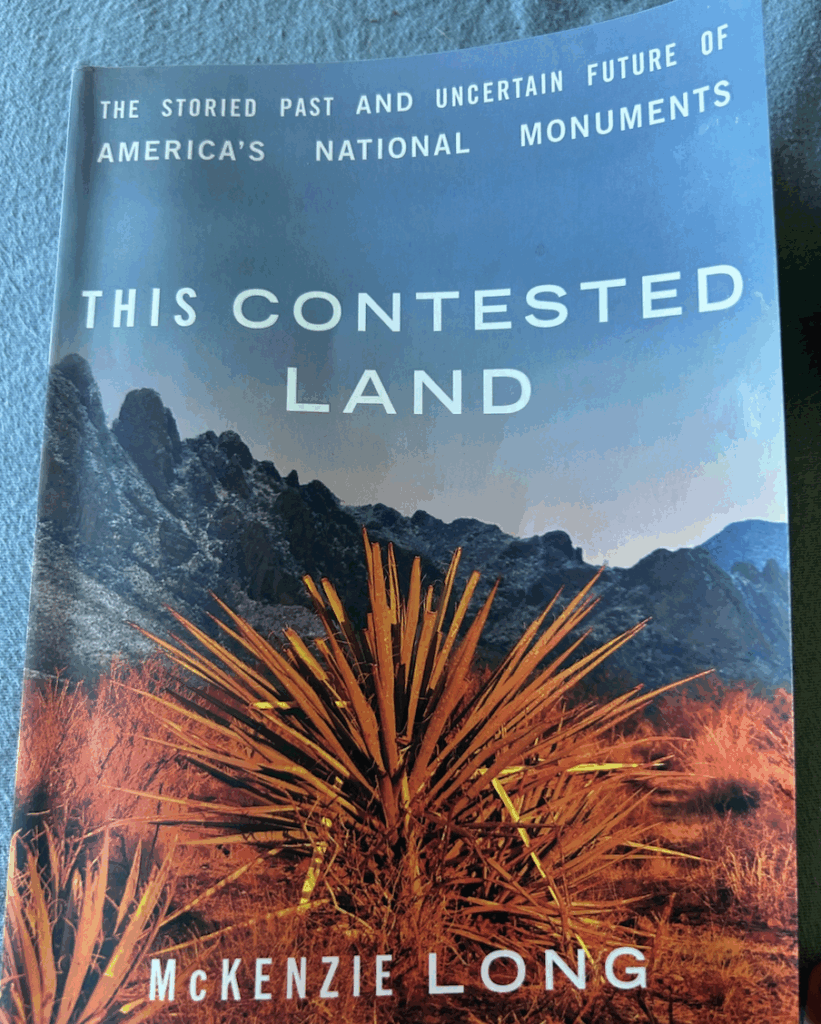
Last week I was looking through the pile of book and journals next to my sofa, and I started reading a journal that I subscribe to: Western American Literature, a Journal of Literary, Cultural, and Place Studies. The edition was from last Winter but I don’t think I ever read it. I started reading it and got to the book review section and started reading a review of This Contested Land written by McKenzie Long. As I read, I’m underlining and highlighting. 

The reviewer, Talley V. Kayser wrote, “using her own outdoor adventures to frame meditations on the histories, presents, and futures of national monuments in the United States.” I’m intrigued. I keep reading. A quote from Long states: “Monuments are quintessentially American. After all, what is more American than disagreements over the scope of governmental powers.”

Note: National parks are protected due to their scenic, inspirational, education, and recreational value. National monuments have objects of historical, cultural, and/or scientific interest. And, most importantly: Congress designates national parks; presidential proclamations establish national monuments, thus the scope of government powers quote above.

Kayser wrote “Long emphasizes the relations (from romantic affairs to family ties) that shape and sustain her journeys.”

After reading the review, I immediately searched for the book online and bought it through the Glacier National Park Conservancy

When the book arrived I couldn’t put down.  All weekend I worked around reading this book. I enjoyed Long’s writing perspective; an outdoor adventurer telling her personal story with a backdrop of the these 12 national monuments. The writing is crisp and clear; I am taken to each place. I write comments in the margins of my book, and highlight key phrases. I write about how I need to get more involved where I live and advocate for the issues I care about: public lands, clean water, clean air, biodiversity, recreation and conservation.

I’m just thrilled to get back into reading and learning more about the world. I’ll write a full review of each book as soon as I finish. I would love to hear your comments. 

And, I don’t read one book at a time when I’m back on a reading bender. I read several. Here’s what I’ve been reading.

America for Americans; A History of Xenophobia in the United States 

and 

The 12-Week MBA.

ABL – Always be Learning

Bismarck North Dakota, Theodore Roosevelt National Park

I’ve been planning this trip for two years and finally made it to North Dakota and Theodore Roosevelt National Park.

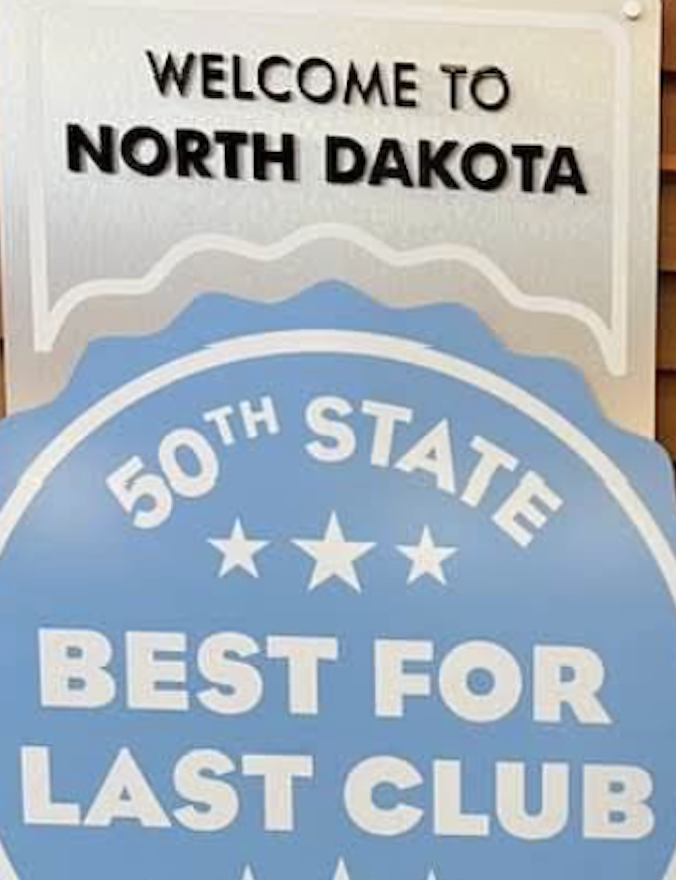
I can now say, I’ve been to every US state. 

Last year I canceled this trip because Hurricane Helene hit my area and I was too afraid to leave. (Read: leave my dogs at a kennel that could be impacted; it wasn’t but I didn’t want to risk it.)

On Thursday, September 18 I finally arrived in North Dakota; on schedule and as planned. My hotel was a bit dated and my room smelled, but an ideal location – close to the airport and walking distance to restaurants. I arrived at midnight which was not ideal, but it was the plan, since the day before I was at a conference.

On Friday morning I slept in a bit and then headed west to Theodore Roosevelt National Park and the South Unit. The drive was all interstate and easy.

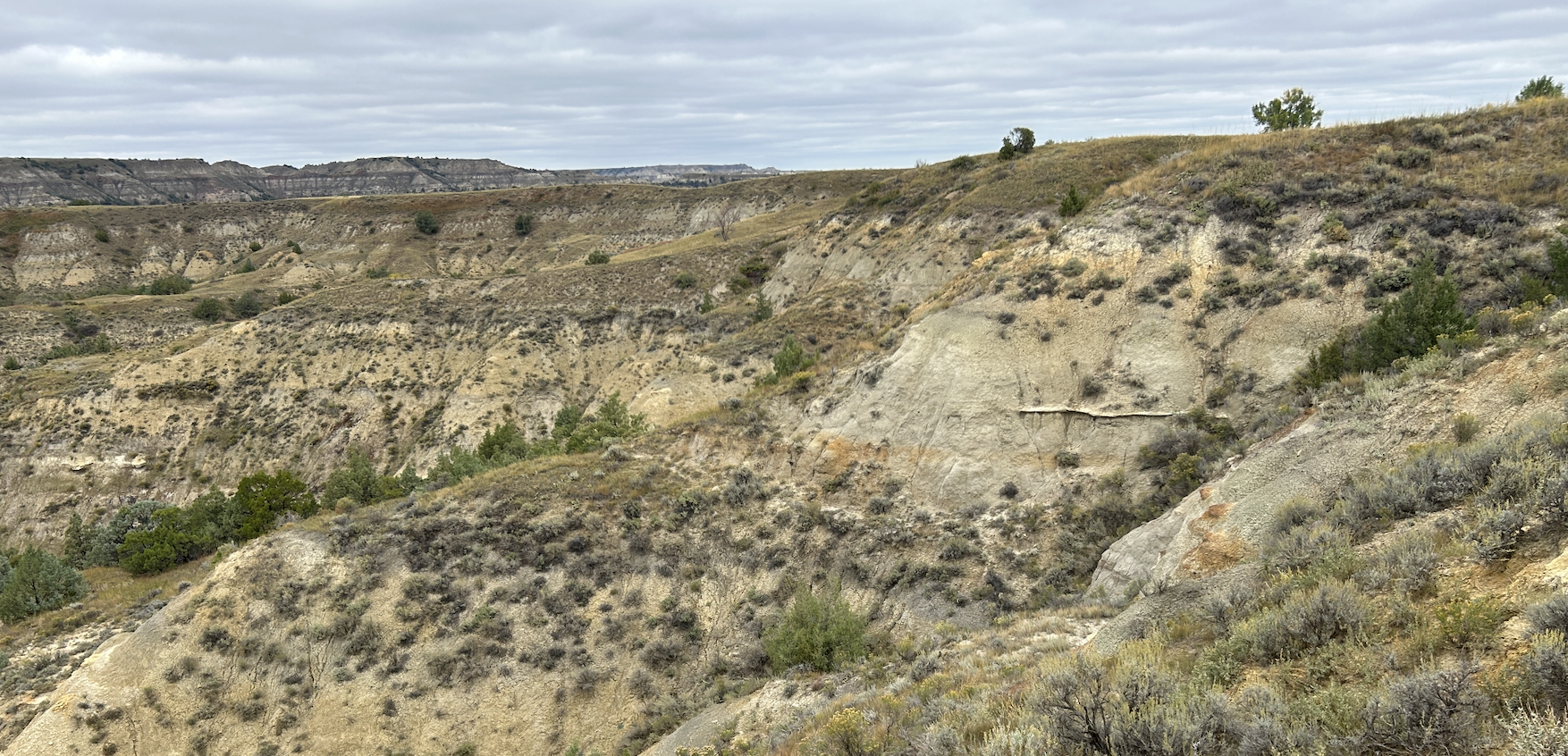
I stopped at the Visitor Center and watch the introductory movie. The themes of this park were about extremes. It was the extremes in the land that created this remarkable landscape. These are the Badlands, not to be confused with Badlands National Park. 

Badlands are dry land with sedimentary rocks and clay-type soils that have been extensively eroded producing ravines, buttes, and hoodoos. I read an interesting sign about buttes. They are NOT mountains but created from erosion. 

I loved listening to Roosevelt’s story, North Dakota and the wilderness changed and inspired him. I knew his story from reading Gessner’s book but loved hearing it again. “The rugged landscape and strenuous life that [he] experienced here would help shape a conservation policy that we still benefit from today.”

I drove the Scenic Drive, and stopped at scenic overlooks and hiked from two of the  trailheads. The entire loop wasn’t open so I drove what was. I saw bison and prairie dogs. While hiking on Upper Paddock/Talkington Loop I talked to a couple who were taking pictures of the prairie dogs. I continued for a mile and then turned around. I saw people on horseback in the distance and started to wonder if I would encounter any wildlife. I started to get nervous. As I hiked back I saw the couple again and they showed me a video they took of a coyote. I was in the video – it ran behind me to hunt prairie dogs, and I wasn’t even aware of it. WOW! She sent me the video but it was very blurry but I could see it run behind me and was so glad I didn’t see it. 

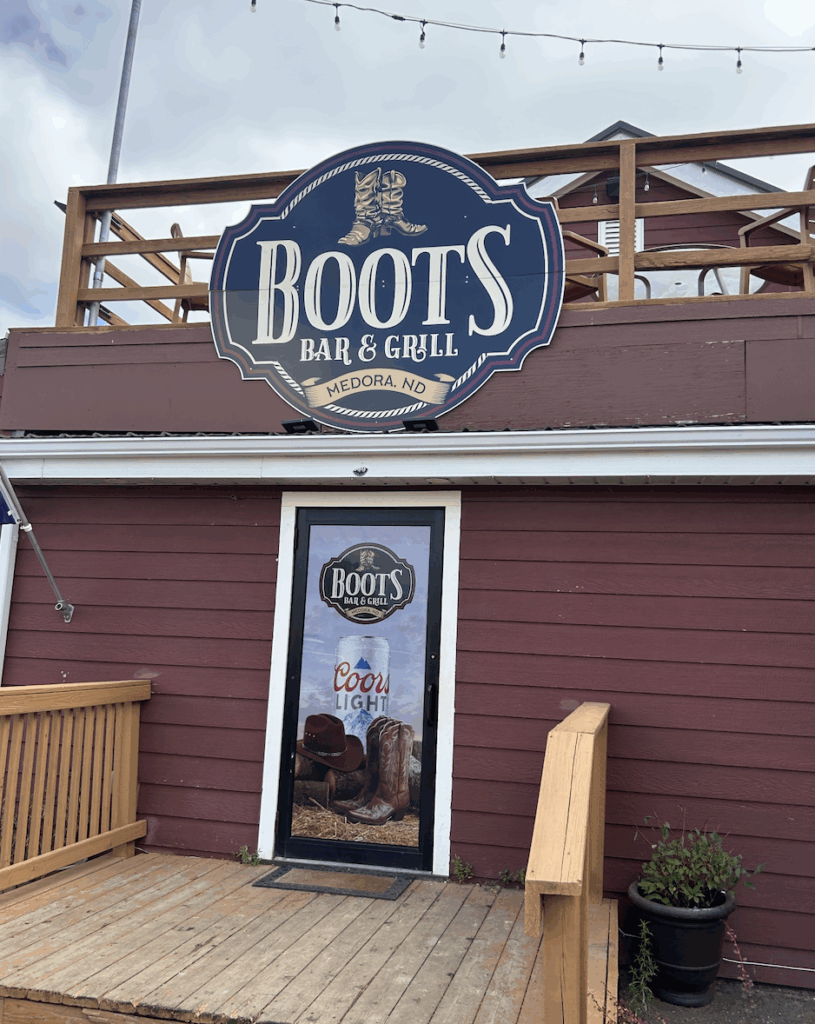
I stopped for lunch in Medora – Boots Bar and Grill.

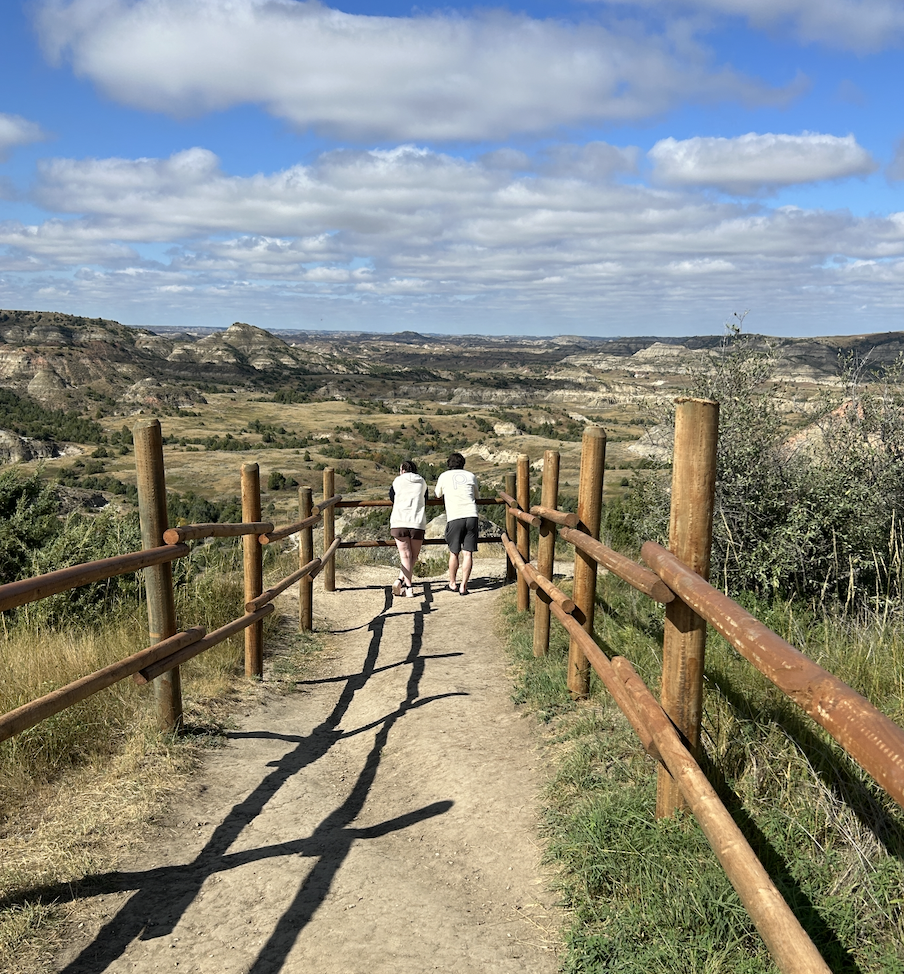
Then I stopped at the Painted Canyon Visitor Center for a final hike. The hike went down into the canyon on a nature trail. 

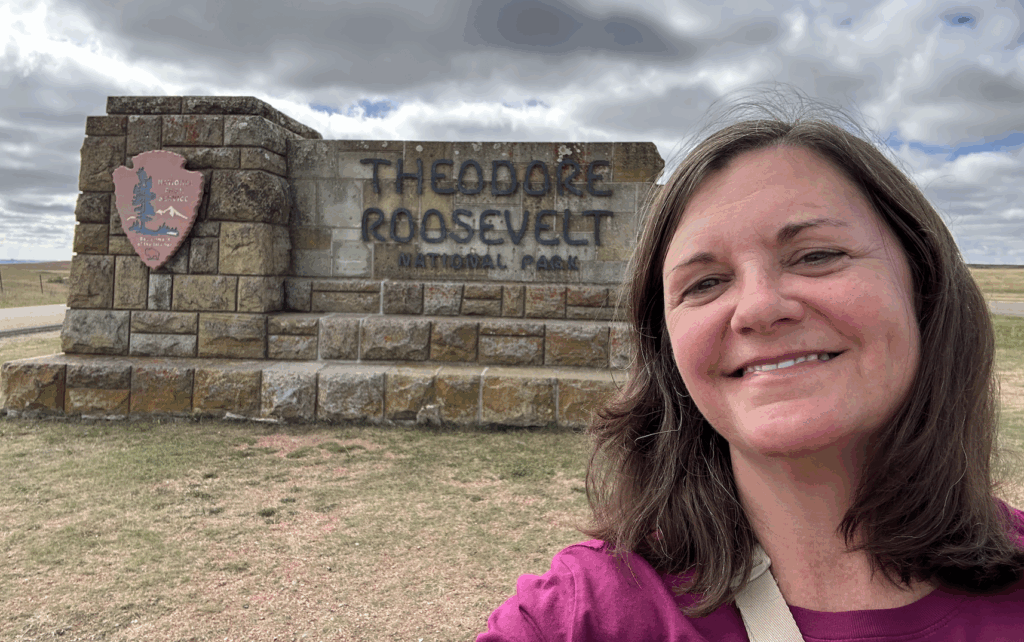
I took my obligatory selfie in front the the national park sign.

Then drove back to Bismarck and had dinner downtown. I walked around the city and then headed back to the hotel. 

North Dakota is in the exact center of North America, which is a perfect way to end my quest to see every state in the US. 

I still have so many lists and so adventures I want to experience. There is so much to see and do.