Great Fiction to Read Patchett, Evans

I’ve been reading a lot lately, instead of running and hiking. It’s been so cold here (22 degrees as I write this) and I just want to sit on the sofa and read, with my dogs next to me. 

All my fiction-reading started with a review of the book, The Correspondent. I haven’t read fiction in a long time so I thought it would be a good change. When I looked at my bookshelf for something to read – all I saw was nonfiction. I needed to escape into fiction. 

The Correspondent is a book of letters that the main character wrote to her friends, family, authors and newspapers. What made this book so special to me was how deeply invested I became in all of the characters. They felt real to me and I could imagine where they lived and how they looked. I cared about their choices, their regrets, and the things they wrote to each other. 

I couldn’t put the book down and read it in two days. By the end, I was crying my eyes out.

The main character did all the things she was scared of. She was one tough woman. She made some bad choices throughout her life, like we all do.  It reminded me how powerful people’s stories are, and it made me want to write letters, reach out to family, friends AND newspapers and tell them exactly how I feel.

More than anything, it was a gentle but persistent reminder to fully live all of our days, no matter our age or where we think we are in life. I also think it was a lesson about aging.

It was my reminder that every person in my life is complex. I will never know what their inner life is. And, I will never truly understand why people do what they do. I think that is why I was balling my eyes out. We can never really know the people we love.

Additionally, I rarely read books from the New York Times Best Sellers list. The Correspondent didn’t land on that list until a full year after publication, purely through word of mouth. I have told every reader in my life, “You have to read this book.” 

After finishing this book, I wanted to start another book as soon as possible. I loved getting back into reading and being so absorbed in a story that I couldn’t wait to wake up to read it or get home from work to read a few chapters. I rarely turned on the TV.

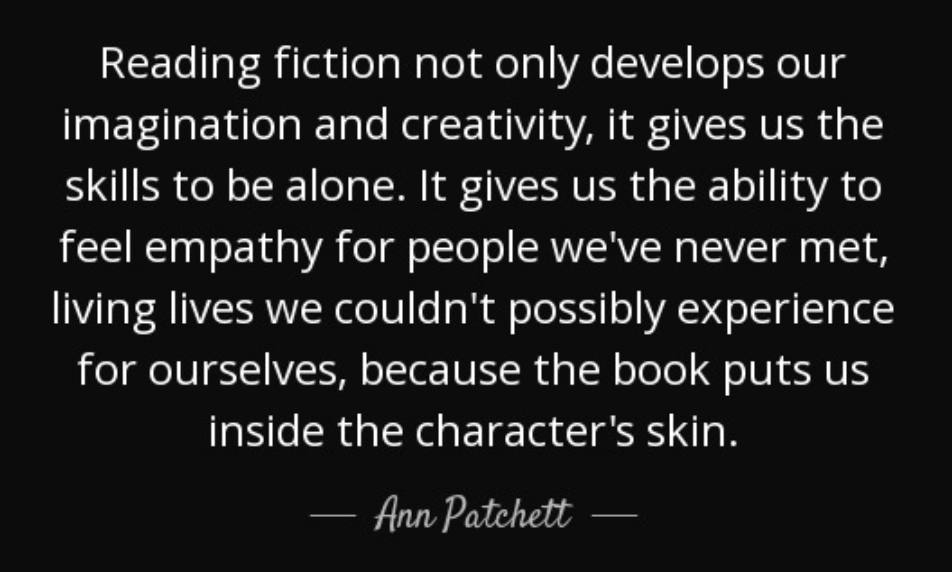
I remembered in The Correspondent , Sybil, the main character wrote a letter to Ann Patchett and Ann wrote back. Sybil wrote to many authors and I thought that was a clever twist, especially when they wrote back so I googled Ann Patchett and read a few reviews of her books. I decided my next read was Tom Lake. I remember hearing about it when it came out but never read it. 

Now, I’m reading it and it’s so good. It takes place in a fictional town in northern Michigan, where I’ve been. Plus, the mom was from New Hampshire and attended the University of New Hampshire, my alma mater. I liked how the story depicted Michigan and New Hampshire, and the fictional summer stock theatre by a lake. The characters are complex and compelling. I was drawn in instantly to the main couples’ story, including the surprise twist in how they met. I loved learning about the personalities of the three daughters. I loved how the mother’s past is slowly revealed through the book. I’m halfway through and can’t put it down (except wanting to write this post – perhaps to draw out the eventual ending to the book)

Patchett is such a great writer and storyteller. I loved, loved, loved her book, The Dutch House and read it twice. I also listened to the audio version narrated by Tom Hanks – so good!

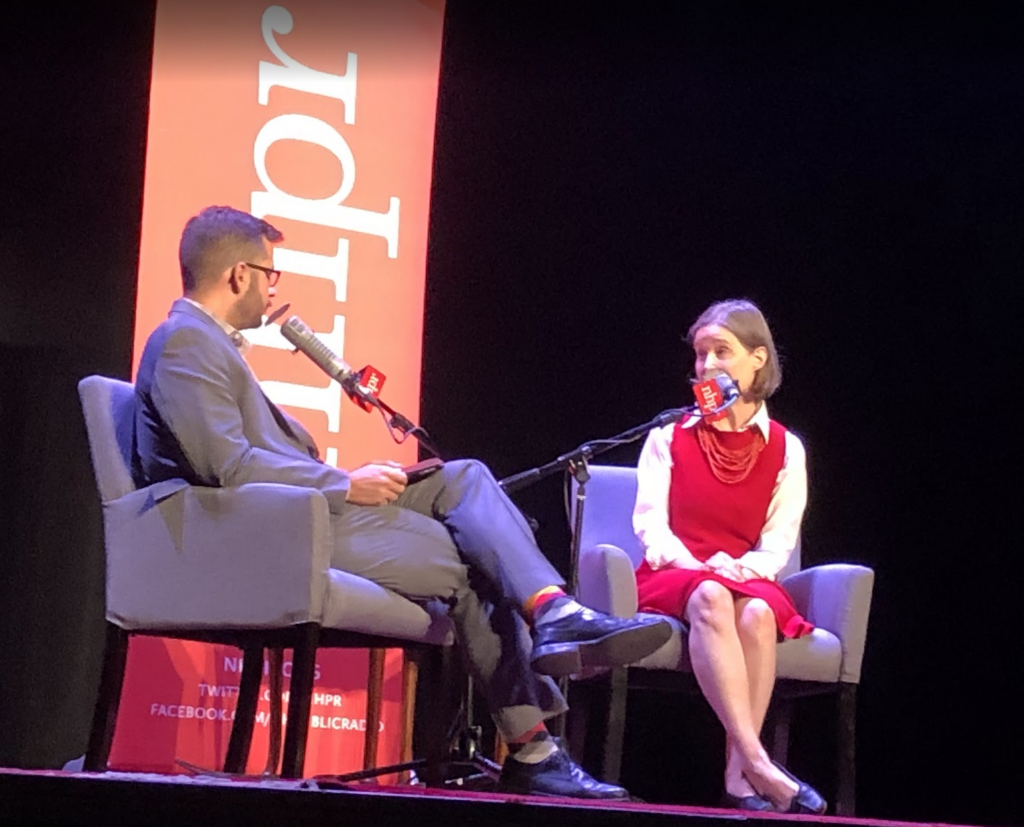
I remembered, too. I saw Patchett speak. It was 2019 and I was living in Concord, New Hampshire. I bought tickets to the event which included a signed copy of her new book, The Dutch House. The talk was held at The Capitol Center for the Arts’ so it was just a short walk downtown. Peter Biello was with her on stage and asked her questions. He worked at NHPR at the time and did a great job on stage. 

I found the above picture in my Google Photos from that night. I sat in the first row and was riveted by the conversation and wanted to learn everything I could about the writing life.

This is what I wrote in my journal from that night:

Ann Patchett was so awesome last night. I started reading The Dutch House once I got home and it’s good. One of the questions that she answered had to do with publishing. She said that it is your name: you do all the editing and make it be representative of your work. She talked about the idea of a home as a central theme in the book. She said our home is where we throw our lives. Home is emotionally charged. Every novel needs a home – it connects people.

She said the book is also about hurt feelings and the things that hurt us in our childhood. The idea that the characters can’t get out of the situation they are in – that is what she likes to write about. 

She said that part of her life she interviews authors and she reads all the time. She has a bookstore in Nashville. She said Margret Atwood’s new book is so good, as is Harlan Cobin. She was funny, smart and made me want to know all her books. 

She said all that matters is the white, hot center of your heart. Find that and write about that. It teaches you to access what you really care about. She said I can’t teach you about having something to say. Writing a novel is like swimming the channel. You have to stay in the present and you can’t look forward and you can’t look back. 

She said find the time to do what you love. If you have something to say you will find the time.

She makes me feel like reading and watching the news and being involved in this crazy world.  Going to an author reading does energize me and brings me back to the world. I laughed and genuinely enjoyed the conversation. She was really engaging.

Twenty years ago I bought Patchett’s 2004 memoir, Truth & Beauty, about her friendship with Lucy Grealy. I thought her story of coming up as a writer was fascinating. 

The point of this post is really just this: Ann Patchett is amazing- Read Her Books!  Virginia Evans is a wonderful storyteller – Read This One. These books have gotten me through a cold, snowy winter in East Tennessee.

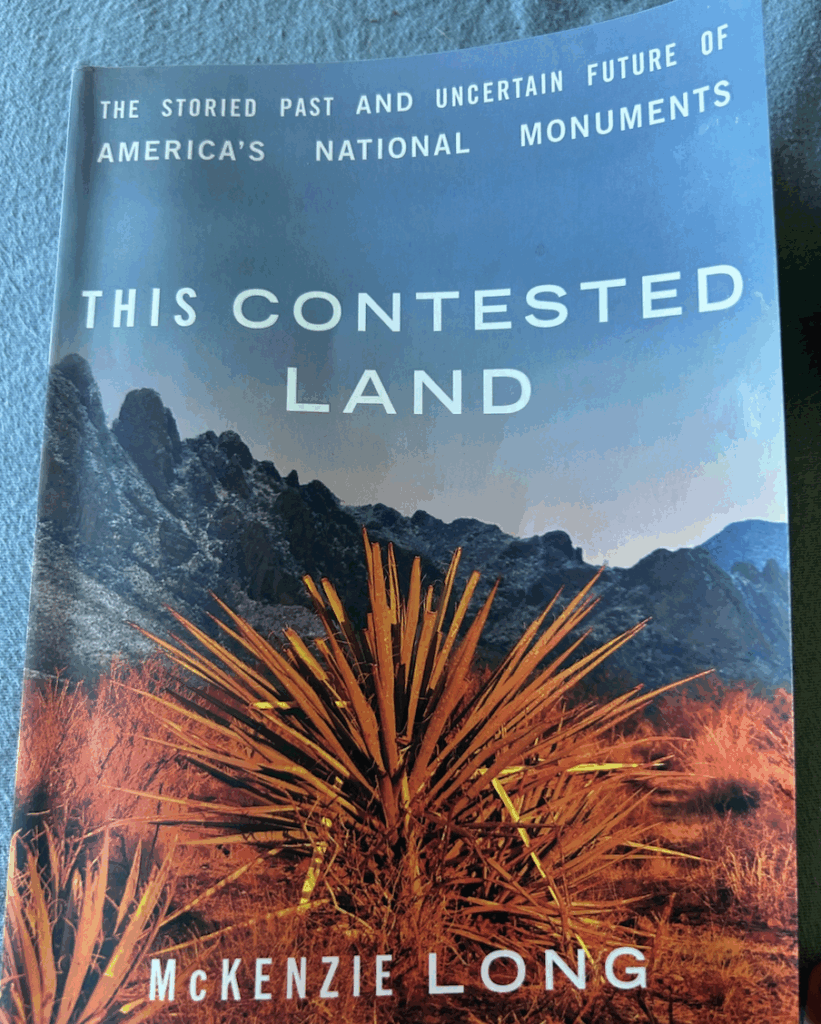
Fall Books I’m Reading – This Contested Land by Long

It’s always this time of year I want to go back to school to get my masters or to learn new skills. I think to myself, I have enough money to go back to school, but then reality hits, and for tens of thousands of dollars I think I want to travel or put in a new kitchen … Maybe, let’s see what next fall brings. 

In the meantime, I’m in full on reading mode because it’s how I learn; and books always make me want to travel.

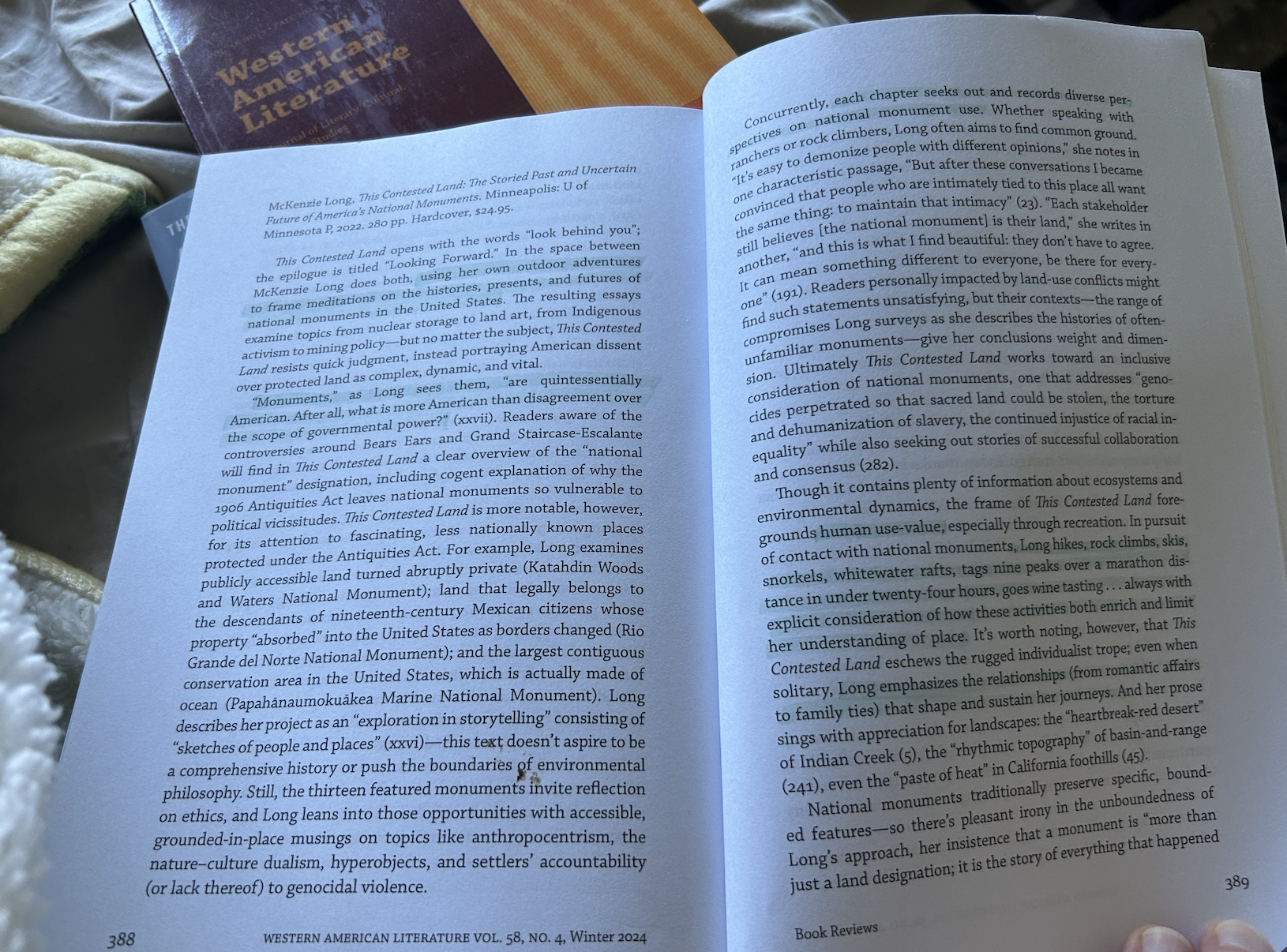
Last week I was looking through the pile of book and journals next to my sofa, and I started reading a journal that I subscribe to: Western American Literature, a Journal of Literary, Cultural, and Place Studies. The edition was from last Winter but I don’t think I ever read it. I started reading it and got to the book review section and started reading a review of This Contested Land written by McKenzie Long. As I read, I’m underlining and highlighting. 

The reviewer, Talley V. Kayser wrote, “using her own outdoor adventures to frame meditations on the histories, presents, and futures of national monuments in the United States.” I’m intrigued. I keep reading. A quote from Long states: “Monuments are quintessentially American. After all, what is more American than disagreements over the scope of governmental powers.”

Note: National parks are protected due to their scenic, inspirational, education, and recreational value. National monuments have objects of historical, cultural, and/or scientific interest. And, most importantly: Congress designates national parks; presidential proclamations establish national monuments, thus the scope of government powers quote above.

Kayser wrote “Long emphasizes the relations (from romantic affairs to family ties) that shape and sustain her journeys.”

After reading the review, I immediately searched for the book online and bought it through the Glacier National Park Conservancy

When the book arrived I couldn’t put down.  All weekend I worked around reading this book. I enjoyed Long’s writing perspective; an outdoor adventurer telling her personal story with a backdrop of the these 12 national monuments. The writing is crisp and clear; I am taken to each place. I write comments in the margins of my book, and highlight key phrases. I write about how I need to get more involved where I live and advocate for the issues I care about: public lands, clean water, clean air, biodiversity, recreation and conservation.

I’m just thrilled to get back into reading and learning more about the world. I’ll write a full review of each book as soon as I finish. I would love to hear your comments. 

And, I don’t read one book at a time when I’m back on a reading bender. I read several. Here’s what I’ve been reading.

America for Americans; A History of Xenophobia in the United States 

and 

The 12-Week MBA.

ABL – Always be Learning

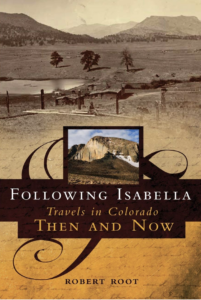
Following Isabella and My Colorado Adventure, Book Review

Robert Root writes the story of how he followed Isabella Bird’s three-month (Sep-Dec) journey at age 42 through the Front Range of Colorado in 1873. While Bird seeks to understand this place, Root seeks to see what Colorado will mean to him after living most of his life in Michigan. 

He writes about that first view of the Rocky Mountains while driving from the plains; it is impossible to forget. It is a spellbinding moment of beauty and awe – that first glimpse of snow white peaks in the distance. He enters Colorado from the east similar to all migratory Americans, and me too. (17)

I know that view he describes from driving west from Maine in 2004. Like early adventures and explorers Root is lured west by the promise of new beginnings. 

As an outsider, Bird entered each new world with an openness to experience and an intention to record what she encountered. (19) I think this is a similar sentiment for me. I feel like every new trail or new state I move to there is an intention to record it and understand it. 

Bird was labeled high strung along with being an adventurer. In 1873 there were few women adventurers exploring the frontier.  Root writes her health improved while traveling. When home, she “wilted”. Her life was traveling and exploring but she preferred the less traveled parts of the world. She was always looking for the path less traveled, less populated areas. Also, novelty and freedom kept her healthy, Root writes. And this 1873 Colorado  challenged her resourcefulness and curiosity. A place unfettered by duties to her family and society is the world she created for herself. The plains and the makeshift settlements unsettled her but once she reached the canyons and mountains she remarked: 

“the canyon became utterly inaccessible…this was exciting; here was an inner world.” (47)

When she entered Estes Park, she came alive.

 “Mountain fever seized me”, she writes in her journal.

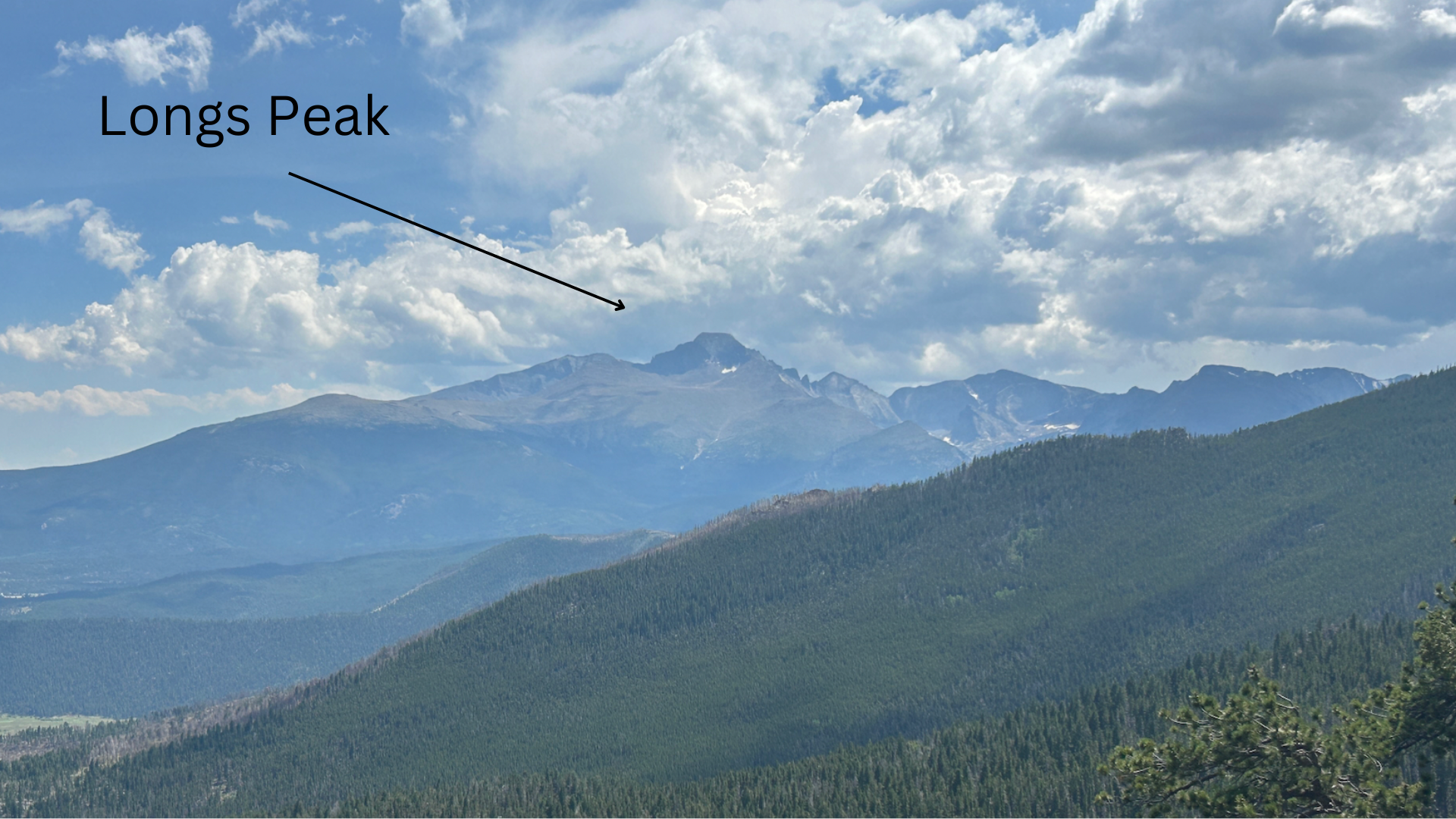
Root writes that she didn’t have much interest in the science of the place; she was interested in the mood it created in her or the circumstances it created for her. (63) I am captivated by her journal writing about the hike to Longs Peak. I just so happen to be reading this section of the book on the plane as I fly from Knoxville to Denver knowing I will see the peak in the distance. I never thought of climbing Longs, even after 10 years of living in Colorado but for some reason, I want to now. Maybe it is the emotion she writes about the trail to the top. I want to experience it the way she does. 

Root writes that Bird worried about writing about beautiful places because you don’t want the masses to find it. Similar to other nature writers, particularly Edward Abbey, she wanted to keep it to herself and unspoiled. 

Root reflects on Bird’s writing and his, and defines memoir and compares it to autobiography “Autobiography is a chronological art, an act of recordkeeping with commentary, not, like memoir, an attempt to revivify a period of the past, make it possible for another person to live the moment too through reading. Autobiography eschews the intimate, the commonplace detail,  the unexceptional private life; memoir embraces them.” (113)

Are you a sticker or a transient? Root answers: “If you stay too long in one place you can no longer  call yourself a transient or a traveler. You’ve become an inhabitant and you spend your time learning how to dwell there, day by day. For most of us, perhaps, this inevitable change is not only expected but anticipated. For Isabella Bird, it was frustrating and unacceptable.” (271)

I’m not a sticker but I’m not transient either – I think, maybe.

Bird came to Colorado on a recommendation of a friend, writes Root. She found more than she expected and didn’t expect to stay longer than she did. She traveled to remote places, places on the edge of the frontier, and avoided settled places. She preferred the wild and less cultivated areas. She went on to other places and wrote books about the other places and never mentioned Colorado again; and she never came back. She wanted to be in motion and test her limits. She retreated from a regulated life of responsibility and obligation and social constraints. 

Root is a nonfiction writer of place who wrote this book after moving to Colorado. He falls in love with the place as he follows Isabella’s travels in the Front Range. 

Like Root, I love to explore new places and find its “distinctive qualities” and learn its natural and cultural histories. “I’ve merely wanted to know where I am…I like who I am when I’m here,” he writes. I can say the same thing about the mountains towns I’ve lived in. I consider my current place, Sevierville a mountain town. 

Root ends his book with a pithy statement about Colorado that rings true to me and my discovery, while living in different places: “I can imagine moving on. I can’t imagine letting go.”

“The mountains are hard to ignore, hard to be complacent about, and yet the sight of them so often startles me, stuns me, as if I’m repeatedly discovering them anew.” (265)

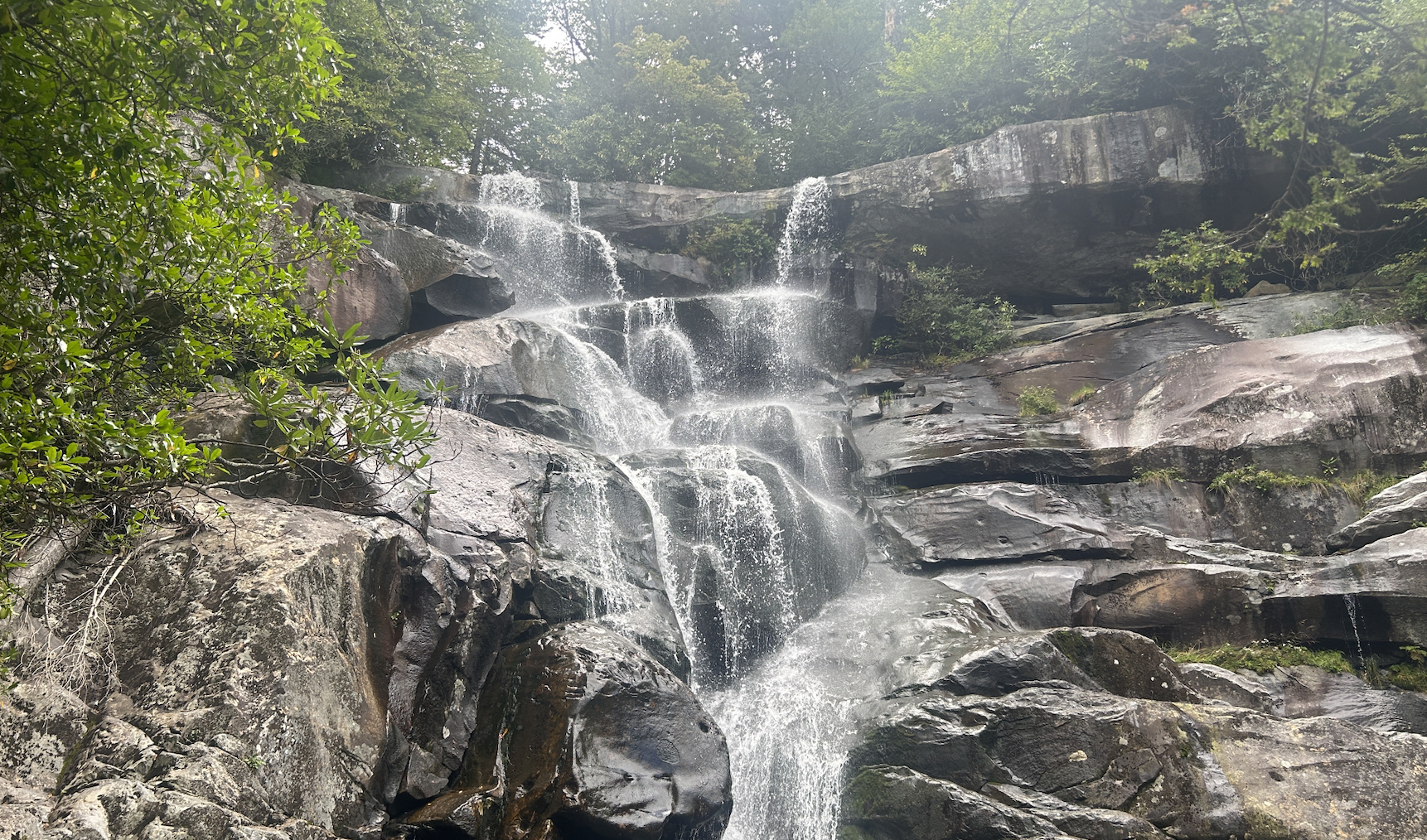
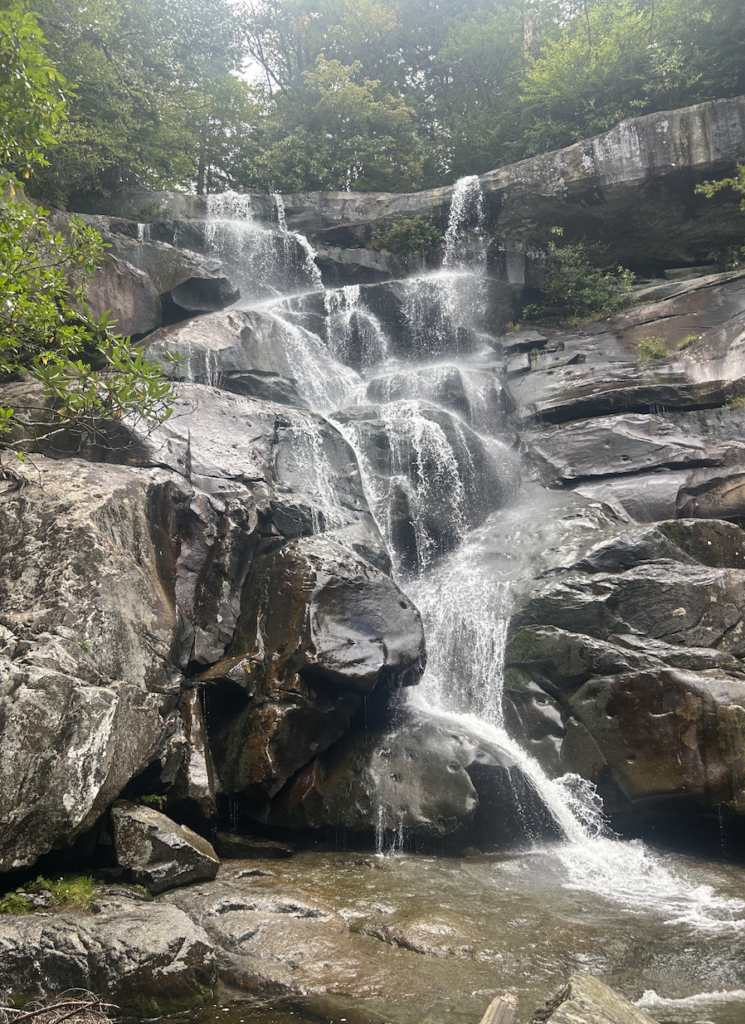
Ramsey Cascade in September

Last weekend I decided to run/hike to Ramsey Cascade in Great Smoky Mountains National Park. I needed more than 8 miles for my training plan so I parked at the bridge that crosses Middle Prong at the intersection of Greenbrier Road. The total miles for the day: 11.2 miles and 2,680 feet of elevation gain. 

Parking remotely turned out to be the best idea because trailhead parking for Ramsey Cascade fills up quickly, and when I ran through the parking area on the way back there were many strange parking jobs where multiple cars looked stuck. And so many people by noon. 

I started early as always and only passed four hikers going up on this Sunday in September.

Trail maintenance has been ongoing during the week. Rock steps and ladders are this hiker’s dream. The closer to the end of the trail, the more ladders are present.  This construction does close this trail right now Monday through Thursday. 

The Ramsey Cascade trail is about 60% runnable. There are rocky parts and steep parts, and various flats and straight up parts; it’s a trail runner’s dream. When I cross streams or get close enough to the rushing water, I am able to throw water over my head and splash my face with the cool water to stay cool.

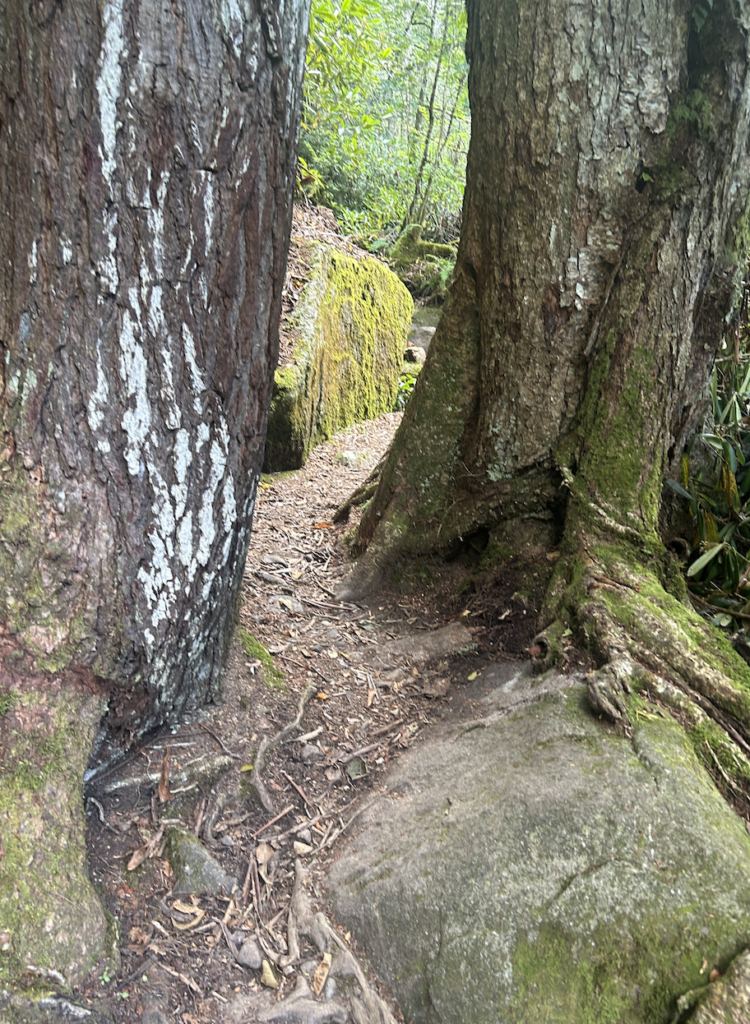
My favorite part of this trail is looking for the huge Tulip Poplar tree. I’ve seen so many old time photos of people holding hands around this tree for perspective. One day I will do the same if I hike it with a group of people. 

The closer I get to the waterfall the louder the water becomes and it’s thrilling to see the white cascades through the trees on approach. The waterfall is spectacular as always and I could stare at it for hours. This was my second time on this trail and first time trying to run it as much as I could. 

As I headed down I talked to another solo hiker and she told the story of how she comes to Gatlinburg every year and likes to hike this trail. Before all the new trail construction the boulders were so big that an older man got stuck and search and rescue had to get him. I told her how thankful I was for the trail maintenance done on this trail. It such a popular, it really is needed. I passed about 30 people going up. 

The leaves aren’t changing yet but I can’t wait to get back there for another run and see the fall colors. 

This week I finished reading Strangers in High Places; The Story of the Great Smoky Mountains by Michael Frome. The book is so good, so compelling, so well written, that I read it in a week. I like how Frome starts with the Eastern Cherokee history, and sad removal, and then moves to the mountain people and lumbermen. He writes about the moonshiners and revenuers (IRS), bears and all about the park’s boars/pigs.

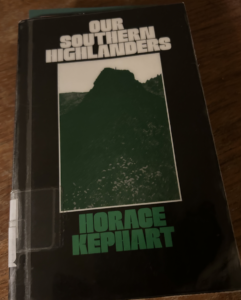
The longest section is about the legislation surrounding the Smokies becoming a protected national park. He writes about land transactions surrounding the creation of the park and all of the ongoing personal interests that are threats to it. He wrote about Horace Kephart, and how Kephart left his family and moved to the North Carolina woods to start over. He later became a folk hero to many mountain people. I had to learn more about him so I’m now reading Our Southern HighlandersThe full text is here courtesy of The Project Gutenberg.

I would argue that these two books should be required reading for anyone who loves the Great Smokies and wants to understand its history. 

August hike to Charlies Bunion GSMNP

The hike on Sunday to Charlie’s Bunion was a great day to be in the mountains. As I started on the AT from Newfound Gap I was thankful for cool temperatures and to see a few other solo, women hikers on the trail. I saw a few trail workers and hikers who have been on the trail a few days. 

I love being on the AT. While I do not have aspirations to through-hike this trail, I can appreciate the patience and dedication it takes to complete the feat. 

While hiking I was thinking of the book I’m reading, Following Isabella Travels in Colorado Then and Now. Since I’m traveling to Colorado soon I wanted to get in the Colorado spirit by reading about its history by Robert Root. But it got me thinking about the trip I just booked to Maine. I thought I should start reading a book about Maine to get in the spirit of traveling there. I start thinking about what I should read and Sarh Orne Jewett comes to mind. I have her biography and I’ve been to her house in South Berwick. I obsessively read about her many years ago. 

As I’m hiking I remember reading about Willa Cather and how she and Jewett wrote letters to each other, encouraging each other in their writing life. That advice is good: “Find a quiet place with the best companions.” Which is what I’m always unknowingly searching for in this life. 

While hiking I think of so many things I want to do. My mind wanders to books and people and places, and suddenly I’m deep into the mountains.

After 4 miles, I climbed to the rocky top of Charlie’s Bunion with expansive views of the mountain peaks. 

I hope to one day learn all the names of the peaks I see but for today, I just took in the view and was happy to be in the Smoky Mountains. 

On the way back to the car I talked to a father who was hiking with his two young girls. They hiked to the Jump Off for the sunrise. I love seeing young kids hiking on big trails. The girls were sweet and seemed thrilled to be hiking this morning. 

I passed about 15 people on the way back to the car, and I even saw one man in flip flops. 

I’m glad to be back hiking and running regularly. My training plan for the next 12 weeks is a long run on Saturday and a hike/run on Sunday. This plan is going to help me complete miles on the 900 miles map. As of today, I have completed 48.9 miles and I’m 2% done. Next week is Alum Trail to LeConte.